Labeling buyer's workspace
Your product.The right labeling route.
See how products move, where labels land and what needs testing—before choosing a machine.
Find your application.
Start with the product, not just the machine's advertised speed.
 01
Round bottles
A stable product path. A controlled label wrap.
- Start with
- Bottle + label dimensions
- Compare
- Wrap, position + overlap
- Confirm
- Stability + repeatability
Open the assessment guidance
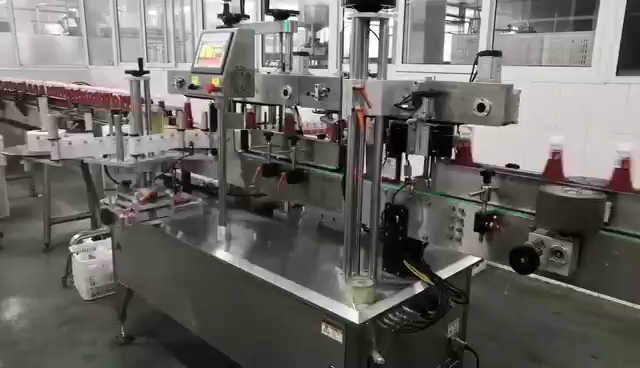
Round bottles and wrap-around labels
Start with the bottle diameter, height, filled weight and stability on the conveyor. Include the label height and length, desired overlap or gap, material and roll direction. A round appearance does not prove that the label area is cylindrical.
Check the actual sample for taper, seams and surface changes. Assess whether the product needs orientation or a controlled stop to position the label. Compare a documented round-bottle route with a vertical system using the real sample rather than selecting by advertised speed alone.
Test: label position, wrinkles, overlap, product stability and repeatability over a representative run. Record sample, settings and conditions with any measured result.
 02
Difficult products
Small, unstable or hard to detect? Start with handling.
- Start with
- Real product + label samples
- Compare
- Handling + sensor suitability
- Confirm
- Feeding + placement
Open the assessment guidance
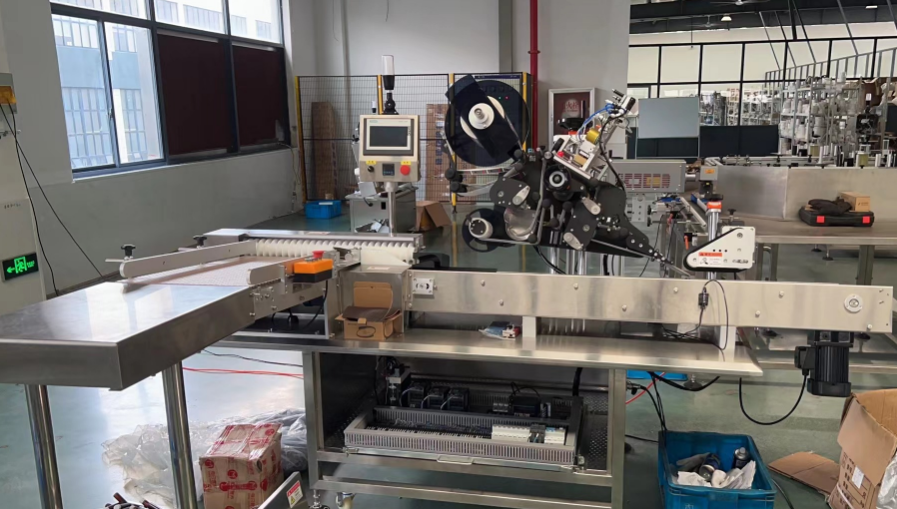
Small, unstable or difficult-to-detect products
Small cylindrical items may need horizontal handling when upright transport is unstable. Flat cartons and pouches need a different handling and support assessment. Transparent labels or containers also require checking the sensing method with actual samples.
Provide representative filled or empty products as they will run in production. Include flexible or uneven surfaces, label stock and expected product spacing. A machine family or photograph cannot establish sensor compatibility or application accuracy.
Test: reliable product and label detection, feeding, support, positioning and changeover. Confirm the acceptable result before treating the application as production-ready.
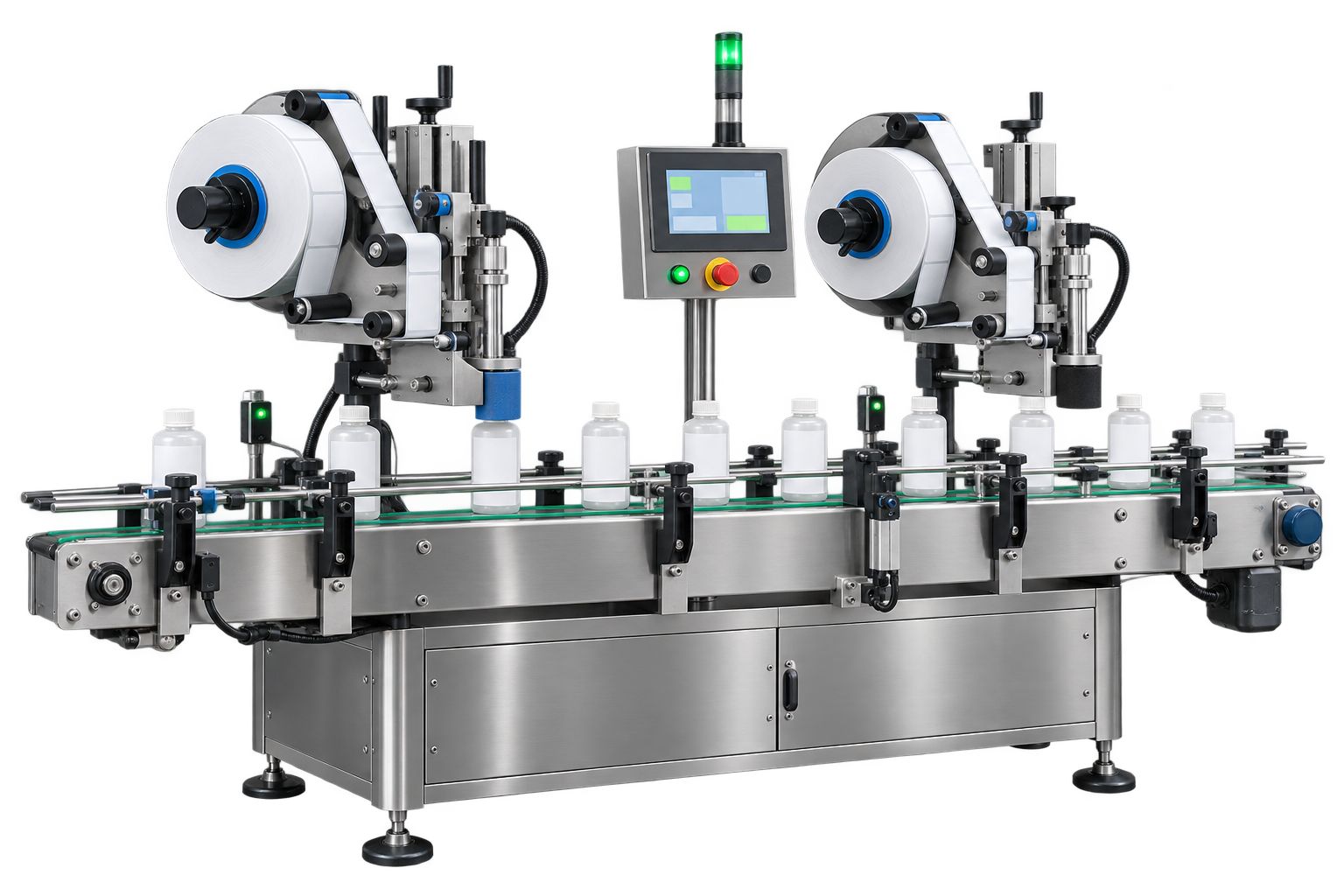
03Dual-applicator continuity
Explore active/standby handover and roll-change requirements.
- Start with
- Roll changes + line conditions
- Compare
- Handover + replenishment
- Confirm
- Recovery under test
Open the assessment guidance
Dual-applicator continuity and changeover
An active/standby applicator concept can be assessed where label-roll changes interrupt production. Two heads alone do not establish uninterrupted operation: the line must support detection, control handover and safe replenishment.
Specify which interruptions you want to reduce, the roll format, label usage, product spacing and required handover behaviour. Integration, guarding and operator access require project-specific engineering review.
Test: an actual roll-end handover, missing-label detection, recovery, rejected products and operator intervention. Do not describe the result as zero downtime until the agreed operating conditions are demonstrated.
Labeling, made visible
Follow the label. Find the right route.
See how product handling, label application and roll changeover affect the machine discussion—not just the model number.
From label roll to product
A sensor detects the product, a peel edge separates a pressure-sensitive label from its backing, and the application system places it. Timing, label stock and product stability all matter.
- 01Detect the product
- 02Dispense the label
- 03Apply and check placement
Handling comes before speed
Stable round bottles, unstable cylinders and flat cartons need different handling. Upright, horizontal or top-side routes are starting points; samples and line conditions confirm the fit.
- 01Upright: stable round bottles
- 02Horizontal: unstable cylinders
- 03Top-side: flat products
Two heads. A continuity concept.
An active and standby applicator arrangement can be assessed for roll-change continuity. Controlled handover, label matching, sensing and safeguarding must be engineered for the actual line.
- 01Head A applies labels
- 02Prepare head B
- 03Validate controlled handover
Illustrations explain operating principles, not a specific machine's guaranteed capability or speed. Product samples, label stock, detection, line integration and safety controls require assessment. Dual-applicator continuity is a configuration concept—not a zero-downtime guarantee.
Interactive application lab
Where should your label go?
Switch the application position and watch the idea take shape. Product geometry and the real label determine the machine assessment.
Choose a label position
Follow a cylindrical surface
A wrap-around application guides a label around a suitable round container. Tapers, seams and surface variation can affect the result and must be assessed.
Bring to the application assessment
- An actual filled container and its diameter range.
- Label width, height, roll direction and material.
- Required coverage, seam position and target output.
Place the brand on a defined face
A front-panel concept targets one face of a container. Product orientation and stable handling matter; front-and-back needs a separate configuration assessment.
Bring to the application assessment
- The face shape and intended label position.
- Container stability, orientation and surface condition.
- Label samples and acceptable placement tolerances.
Label cartons from above
A top-side application places a label on an accessible upper surface. Product height, surface flatness and conveyor handling help define the setup.
Bring to the application assessment
- The product height range and top-surface area.
- Label size, material and application position.
- Conveyor integration and the required output.
Simplified placement concepts, not footage or a configured machine. Adhesive, label stock, container shape, handling and target output require sample testing. No speed or accuracy guarantee is implied.
FROM SAMPLE TO ASSESSMENT
A useful test has a clear brief.
- 01Samples
Representative product and label samples
- 02Position
Required label position and acceptable variation
- 03Output
Target output and run conditions
- 04Changeover
Changeover, replenishment and recovery checks
- 05Review
Written observations, limits and next steps
Watch the real machine video
See the movement. Then test your application.
Real footage, with EN / BM / 中文 viewing notes. No performance promise is inferred from the video.
Video viewing notes—not a speech transcript. Observe the product path and label application. Confirm placement, detection and usable output with your own samples; this footage alone does not verify a model, speed or accuracy.
View the sample-test checklist →Questions to settle before buying
The details, when you need them.
Can I select a machine by speed alone?
No. Published ranges depend on the model and application. Product handling, label dimensions, spacing, stability and integration affect usable output. Confirm your required conditions in a sample assessment.
What should I send for a useful assessment?
Product photos or samples, product and label dimensions, roll direction, target output, required label position and existing conveyor details. State what is known and leave uncertain details open for review.
Does the video prove my product will run?
No. It is an application reference. Your product and label need their own review; the video does not establish an exact model, accuracy or guaranteed speed for your project.
Bring the product. Let's assess the application.
Share your product, label and target output. The practical route starts with your actual conditions.
About this guide · Images & performance confirmation
A practical assessment guide for Malaysian manufacturers comparing bottle labelling, difficult containers and continuous-production concepts. A model specification is a starting point; the actual product, label and line determine suitability.
These are assessment scenarios, not customer installation claims. Published speed ranges are model references, not guaranteed production output. The dual-applicator visual is a concept illustration, not evidence of an installed zero-downtime system.
Application guidance · Updated 13 October 2026